

Reading the Org Chart: Why Corporate Titles Are a Map of Power
Every company runs on a hierarchy, and corporate job titles are the labels that map it. Knowing where a title sits tells you who holds budget authority, who can approve a decision, and how high you need to escalate. For anyone working across companies or countries—where 'Director' can mean a board member in one firm and a mid-level manager in another—reading the corporate hierarchy correctly is a practical skill. This guide walks the full ladder from the boardroom to entry level, explains what each tier actually does, and shows you how to interpret any org chart with confidence. For a deep dive on the executive tier specifically, see our complete guide to C-suite executives.
Worth remembering
Titles signal two different things: seniority (how high in the hierarchy) and function (which part of the business). 'VP of Engineering' and 'VP of Sales' share a level but live in different worlds. When you read a title, decode both axes—level and domain—before you decide how to approach the person.
The Two Realities: Governance vs. Management
A corporation has two leadership structures that people often confuse. The Board of Directors governs the company on behalf of its owners; it does not run daily operations. The management team, led by the CEO, actually operates the business. The board hires, oversees, and can replace the CEO—but it does not manage employees. Keeping this distinction clear is the first step to reading any hierarchy correctly.
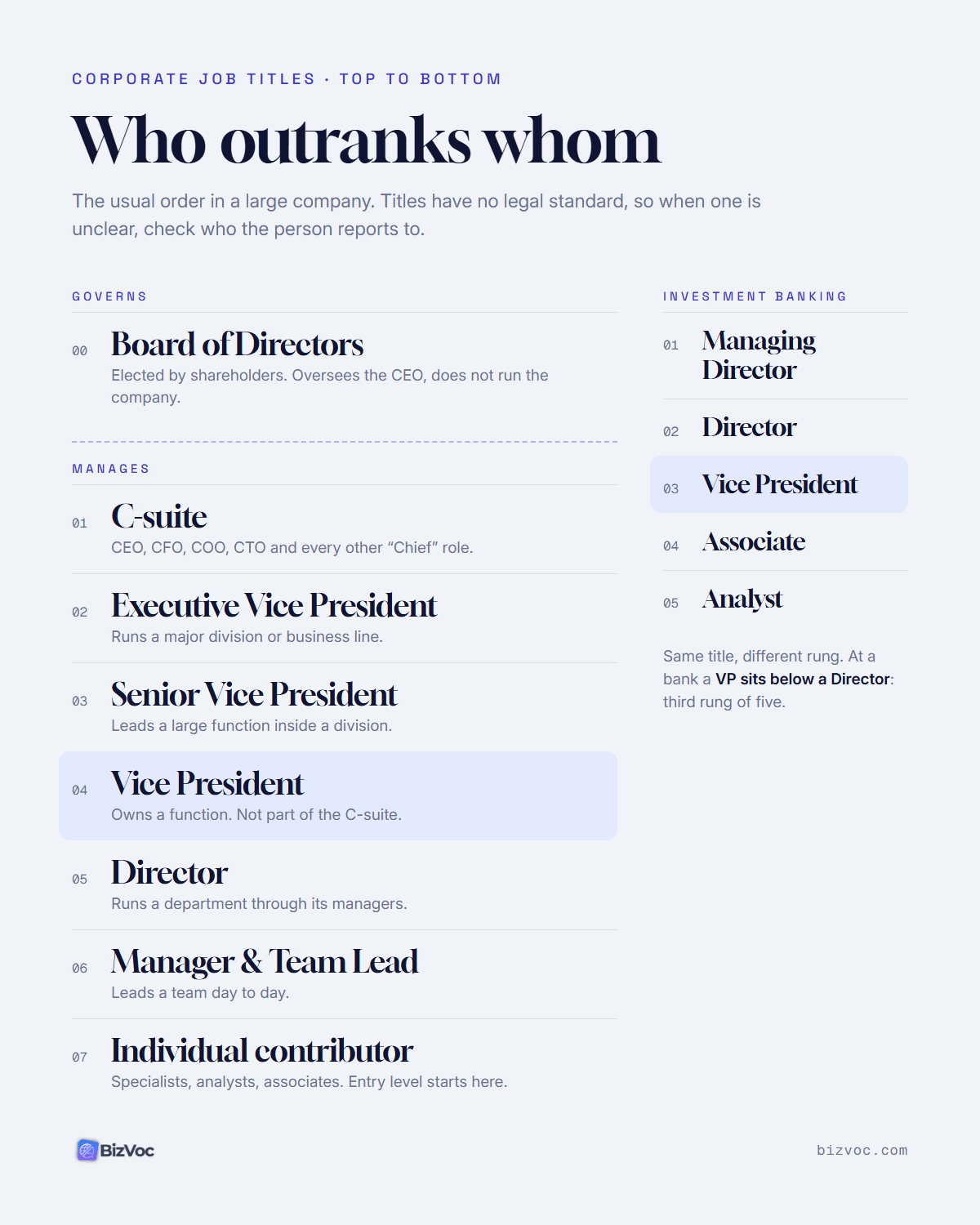
The Corporate Hierarchy, Top to Bottom
Board of Directors & Chairman
The highest governance authority, elected by shareholders. The Chairman (or Chair) leads the board. Board members are typically not employees; they set strategy at the highest level and hold the CEO accountable. 'The board approved the acquisition, but the Chairman asked management to renegotiate the terms.'
C-Suite (C-Level Executives)
The most senior management tier—CEO, CFO, COO, CTO and other 'Chief' officers. They own enterprise-wide strategy and report to the CEO (who reports to the board). This is where 'what comes after the CEO' begins: the rest of the C-suite. 'Every C-suite leader owns one pillar of the company's value.' Learn each role in our C-suite executives guide.
EVP & SVP (Executive / Senior Vice President)
The top tier below the C-suite. An EVP usually runs a major division or business line; an SVP leads a large department or region. In big corporations these are powerful, strategic roles. 'The EVP of International oversees five regional SVPs.'
VP (Vice President)
Heads a function or significant team. The key distinction: a VP owns execution within a function, while a C-level executive owns strategy across the enterprise. Title inflation means 'VP' ranges from genuinely senior to mid-level depending on company size—at a startup a VP may report to the CEO; at a bank a VP can be relatively junior. 'Our VP of Marketing reports to the CMO.'
Director
Manages a department and the managers within it—a bridge between strategy and execution. Note the trap: a 'Director' in management is not the same as a member of the 'Board of Directors'. 'The Director of Product owns the roadmap and leads three product managers.'
Manager & Team Lead
Leads a team of individual contributors and owns day-to-day delivery, hiring, and performance for that team. This is most professionals' first leadership role. 'The Engineering Manager runs a team of eight developers.'
Individual Contributor (IC) & Entry Level
Professionals who deliver the work directly rather than managing people—analysts, associates, engineers, specialists. Modern companies offer an IC track (e.g., Senior, Staff, Principal) that can reach pay parity with management without ever managing people. 'A Principal Engineer can out-earn a Director on the IC ladder.'
SENIORITY AXIS
Board → C-Suite → EVP/SVP → VP → Director → Manager → IC. This tells you how high a title sits.
FUNCTION AXIS
Finance, Engineering, Sales, Marketing, Operations, HR, Legal. This tells you which part of the business the title owns.
Titles in other languages
Titles don't translate one-to-one. A German colleague will call the boss the CEO, but the legal title is Geschäftsführer. In French the formal version is PDG. BizVoc has CEO, CFO, COO, SVP and the other titles as flashcards in German, French, Spanish or Italian, with usage notes like these. It's free while we're in beta.
Try the flashcards free →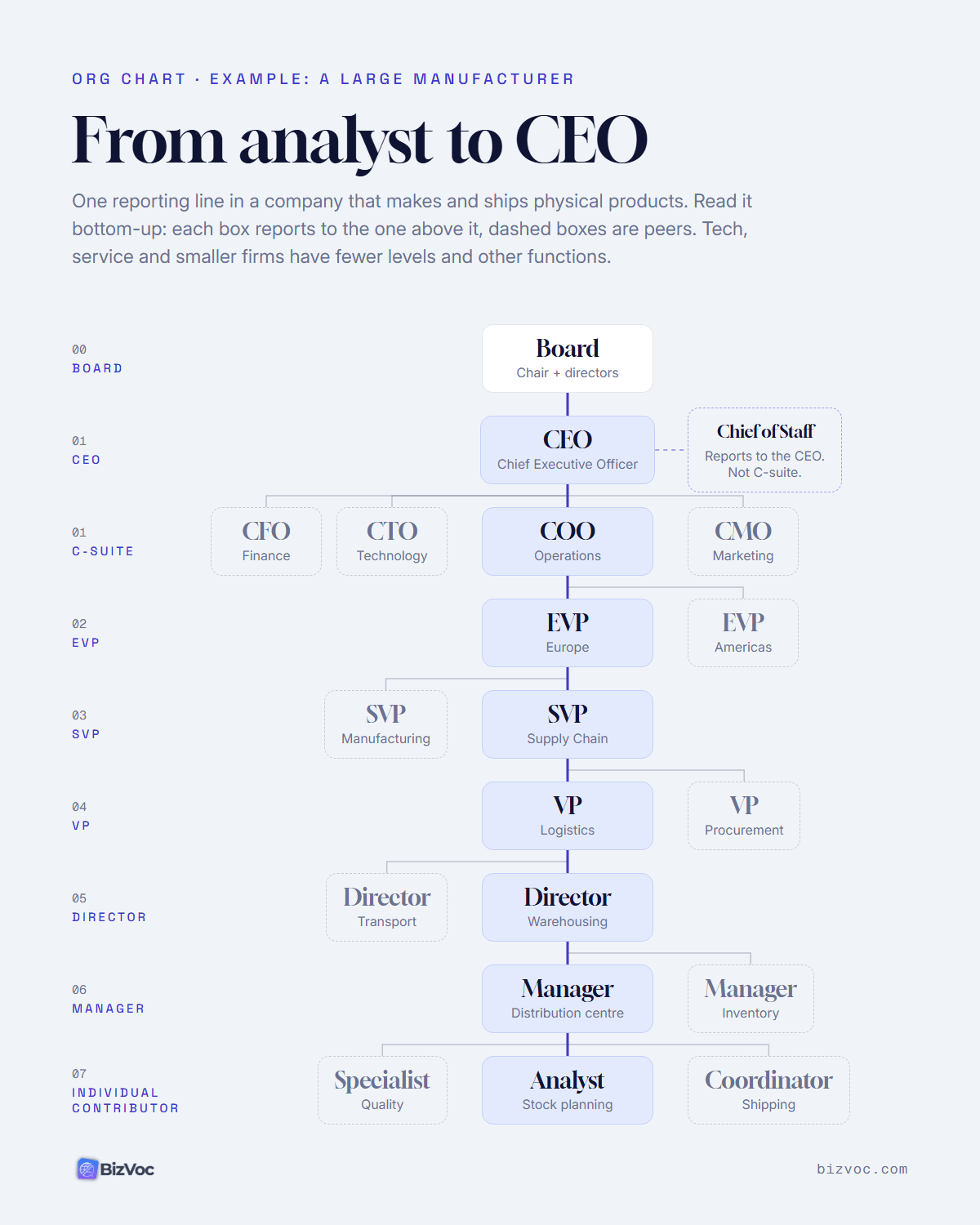
How to Read Titles Across Companies
The same word means different things in different places, so calibrate before you assume:
- Startups compress the ladder: a 'Head of Growth' may do what a VP and a Manager do at a large firm.
- Banks and consultancies inflate titles: 'Vice President' and 'Associate' can be surprisingly junior.
- 'Chief of Staff' is not a C-level role despite the 'Chief'—it is a senior coordinator who runs an executive's office.
- 'President' sometimes outranks the CEO, sometimes reports to them, and sometimes the two titles are held by one person.
When a title is ambiguous, look at who the person reports to and how many people report to them. Reporting lines reveal real authority far more reliably than the label.
Which Title Is Higher? Common Comparisons
Most questions about corporate titles come down to two names side by side. The table gives the usual answer and the main exception. Titles have no legal standard, so treat each row as the default to check, not a rule.
| Comparison | Usually higher | The exception |
|---|---|---|
| VP vs Director | VP | Investment banks run the ladder differently: Analyst, Associate, VP, Director, Managing Director. There a VP sits below a Director. |
| SVP vs Director | SVP | Rarely reversed. In a typical corporation an SVP sits two levels above a Director, with VP in between. |
| EVP vs SVP | EVP | Smaller companies often use only one of the two, so you may see only SVPs or only EVPs below the C-suite. |
| VP vs C-suite | C-suite | A VP is not part of the C-suite. A combined title such as 'EVP & Chief Growth Officer' is, because of the 'Chief' role. |
| General Manager vs Director | Depends on scope | A GM who runs a whole business unit or region with its own profit and loss usually ranks at VP level or above. A GM of a single hotel or store reports to regional directors. |
| Managing Director vs CEO | Depends on country | In the UK and much of Europe the Managing Director runs the company, the equivalent of a CEO (in Germany: Geschäftsführer). In investment banking an MD is the most senior rank on the banker ladder, below the firm's executive leadership. |
| Head of vs Director | Usually equal | 'Head of' is a flexible label. At a startup the Head of Sales may be the top sales person, reporting to the CEO. |
| Senior Manager vs Director | Director | Some companies add a step in between, usually called Associate Director. |
| Group COO vs COO | Group COO | 'Group' means the role covers the parent company and its subsidiaries, each of which may have its own COO. |
Two words cause most of the confusion. Executive in front of a title raises it: an Executive Vice President outranks a Senior Vice President. 'Executive Director' is the exception, because it can mean the head of a non-profit, a senior rank in banking, or a board member who also works in the company. Senior marks a step up within the same level, so a Senior Director is still in the director band, just further along it.
The 30-Day Hierarchy Fluency Plan
Use BizVoc to make this vocabulary automatic and follow this plan:
- Week 1: Map Your Own Company. Draw the chart from the board down to your team. Label each tier correctly.
- Week 2: Decode Both Axes. For ten colleagues, identify their level and their function from their title alone.
- Week 3: Cross-Company Calibration. Compare titles at a startup, a corporation, and a bank for the same real job.
- Week 4: Escalate Correctly. Next time you need a decision, identify the lowest title with the authority to approve it—and go there directly.
Frequently Asked Questions
Q: What is the order of corporate job titles from highest to lowest?
A: From the top: Board of Directors and Chairman (governance), then the C-suite (CEO, CFO, COO and other Chiefs), then EVP and SVP, then VP, then Director, then Manager, and finally individual contributors and entry-level staff.
Q: What position comes after the CEO?
A: Directly below the CEO is the rest of the C-suite. The COO (Chief Operating Officer) is usually regarded as second-in-command, running daily operations. Below the C-suite the ladder continues through EVP, SVP, VP, Director, and Manager levels.
Q: Is a 'Director' the same as a member of the Board of Directors?
A: No. A 'Director' in the management hierarchy leads a department and reports up through VPs to the C-suite. A member of the 'Board of Directors' sits in the separate governance structure that oversees the CEO. Same word, very different roles.
Q: Why do the same titles mean different things at different companies?
A: Because there is no universal standard. Startups compress titles, while banks and consultancies inflate them, so a 'VP' can be senior in one firm and junior in another. To judge real seniority, look at who the person reports to and how many people report to them.
Q: Is a vice president part of the C-suite?
A: No. The C-suite is made up of the 'Chief' officers: CEO, CFO, COO, CTO and similar. Vice presidents usually report to them. The exception is a combined title such as 'EVP and Chief Growth Officer', where the Chief role puts that person in the C-suite.
Q: What is above the CEO?
A: The Board of Directors, led by the Chair. The board represents the shareholders, hires the CEO and can replace them, but it does not run the business day to day. In some companies the CEO also chairs the board.
Q: Is a General Manager higher than a Director?
A: It depends on what the General Manager runs. A GM responsible for a whole business unit, with its own profit and loss, usually ranks at VP level or above. A GM of a single site, such as a hotel or store, typically reports to a regional director.
Q: What title comes between Senior Manager and Director?
A: Many companies use Associate Director for that step. Others use 'Head of' for a smaller team, or go straight from Senior Manager to Director. Check your company's career framework, because the step is not standard.
Q: What rank is a Managing Director?
A: It depends on where you are. In the UK and much of Europe the Managing Director is the person who runs the company, the equivalent of a CEO. In investment banking a Managing Director is the most senior rank on the banker ladder, above Director and Vice President.
Read next
More on corporate language:
From Confusion to Command
Once you can read an org chart fluently, a company stops being a maze of unfamiliar titles and becomes a map you can navigate. You know who to pitch, who to escalate to, and how senior a new contact really is. That clarity is a quiet professional superpower. Use BizVoc to lock this vocabulary into active memory, and you will read—and discuss—any corporate hierarchy with the confidence of someone who belongs at the table.